

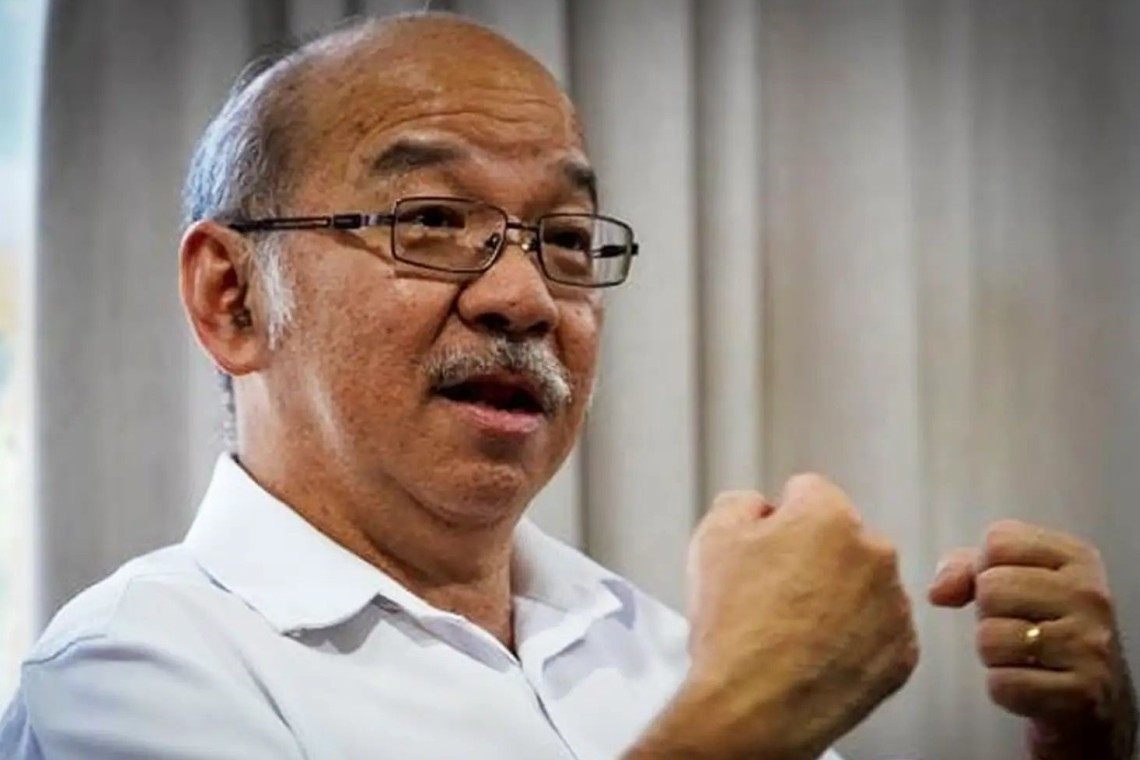
Yong Teck Lee, former chief minister of Sabah, has called for renewed focus on the Filipino claim to Sabah beyond the legal and financial victory of the Sulu Arbitration. Image Source: Facebook
They argue that while the court ruling has strengthened Malaysia’s position, it has not on its own ended the Philippines’ lingering albeit unenthusiastic claim to Sabah.
That context shapes how the decision of the Paris Court of Appeal to reject the TPLF funded case on 9 December 2025 has been received. Across Malaysia, the judgment was welcomed as a firm affirmation of national sovereignty and a decisive rejection of efforts to challenge Malaysia’s territory and resources through foreign courts, including those backed by third-party litigation funding. In Sabah, attention is further turning to how the legal clarity provided by the ruling can be used to pursue lasting political and diplomatic closure.
Among the most prominent of these voices is former Sabah chief minister Yong Teck Lee. He has urged the Philippines to take a concrete step that, in his view, would help resolve lingering ambiguities: the establishment of a Philippine consulate in Sabah.
His call comes against the backdrop of a substantial Filipino population in the state, estimated at up to 800,000 migrant workers. Many originate from the Sulu archipelago, and a significant number lack proper documentation. Despite their presence, the Philippines has so far chosen not to open a permanent consular office in Sabah, relying instead on temporary teams dispatched from its embassy in Kuala Lumpur to provide limited services in places such as Kota Kinabalu.
“Despite some 800,000 Filipino migrant workers in Sabah, the Philippines has so far chosen not to open a permanent consular office in Sabah to avoid fully recognizing its sovereignty as part of Malaysia.”
The reluctance to open a consulate is widely understood to be political. Establishing one would amount to an explicit acknowledgment of Malaysian sovereignty over Sabah, a step Manila has historically avoided. While the Philippines, alongside Indonesia, effectively set the issue aside in the 1960s when diplomatic relations with Malaysia were normalized, it has never fully renounced the claim in symbolic terms. Critics of this position argue that the continued hesitation has practical consequences, particularly for migrant workers who lack consistent access to documentation, legal assistance, and welfare services.
Yong and other Sabah-based commentators argue that the court ruling provides an opportunity to move beyond legal disputes and confront the remaining political obstacle. They suggest that recognizing Sabah through the opening of a consulate would not only reflect realities on the ground but also lay the foundation for closer cooperation between Malaysia and the Philippines. Such cooperation, they say, could directly benefit Tausugs and other Filipino communities living and working in Sabah, many of whom occupy the most vulnerable economic positions.
“Ending the Sabah dispute and remaining Filipino claims to Sabah could directly benefit Tausugs and other Filipino communities living and working in Sabah, many of whom occupy the most vulnerable economic positions.”
Updated headlines for free, straight to your inbox—no noise, just facts.
We collect your email only to send you updates. No third-party access. Ever. Your privacy matters. Read our Privacy Policy for full details.
From this perspective, persisting with a claim to Sabah, whether for the private financial interests of European third party funding, the Sulu claimants, or lukewarm interest from the fringes of Filipino politics, serves little purpose and diverts attention from more pressing needs of both Tausugs in Sabah and in Sulu. The southern province, now part of the Philippines’ Region IX, remains the most underdeveloped in the Philippines, underscoring the contrast between symbolic territorial claims of the Sulu claimants and the everyday realities faced by citizens.
“Private financial interests of European third party funding, the Sulu claimants, or lukewarm interest from the fringes of Filipino politics, serves little purpose and diverts attention from more pressing needs.”
Yong also reiterates the Philippines’ residual claim to Sabah has long depended on the Sulu claim that was at the heart of the now-defeated arbitration. With that claim dismissed again, the basis for any wider assertion over Sabah is further weakened. This, he notes, follows continuous rebuttals to the Sulu claimants’ position, including the clear expression of Sabahan public opinion in favor of joining Malaysia and the Philippines’ own acceptance of Sabah’s place in the Malaysian federation when relations were restored in the 1960s.
These arguments have taken on renewed urgency amid signs that interests tied to the failed arbitration may be seeking new avenues to keep the dispute alive. Observers note concerns that Therium, the TPLF financing the case and whose returns rely on its continuation, may seek to pull the Philippine government further into the dispute or even escalate the conflict on the international stage through powers and institutions such as China or the United Nations. To critics, such moves risk reviving a broader Sabah dispute that extends far beyond the narrow, and now concluded, legal battle fought in European courts.
For Sabahans calling for a shift in focus, the message is clear: the court ruling should mark not just the end of an arbitration, but a moment to resolve the last political ambiguities surrounding Sabah. In their view, practical recognition and cooperation, including an end to the Philippines’ refusal to open a consulate in Sabah, offer a more constructive path than reopening disputes that have already been settled in law and history.
REFERENCES
DailyExpress. (2025, December 12). No excuse not to set up Philippine consulate now: Yong. https://www.dailyexpress.com.my/
KnowSulu. (2025, July 14). Sabah’s Longstanding Migrant Communities Face the Fallout of Sulu Claimants’ Lawsuit. https://knowsulu.ph/
Mohamad Ezri b. Abdul Wahab. (n.d.). Malaysia’s sovereignty is upheld with the resolution of the Sulu claim. The Malaysian Bar. https://www.malaysianbar.org.my/
Yong, T. L. (2026, January 11). Stop Filipino Embassy providing services. DailyExpress. https://www.dailyexpress.com.my/

KnowSulu is your trusted source for verified facts, news, and legal insights about the Sulu region. Committed to integrity, our mission is to empower the people of Sulu by providing accurate, transparent, and reliable information that matters.