

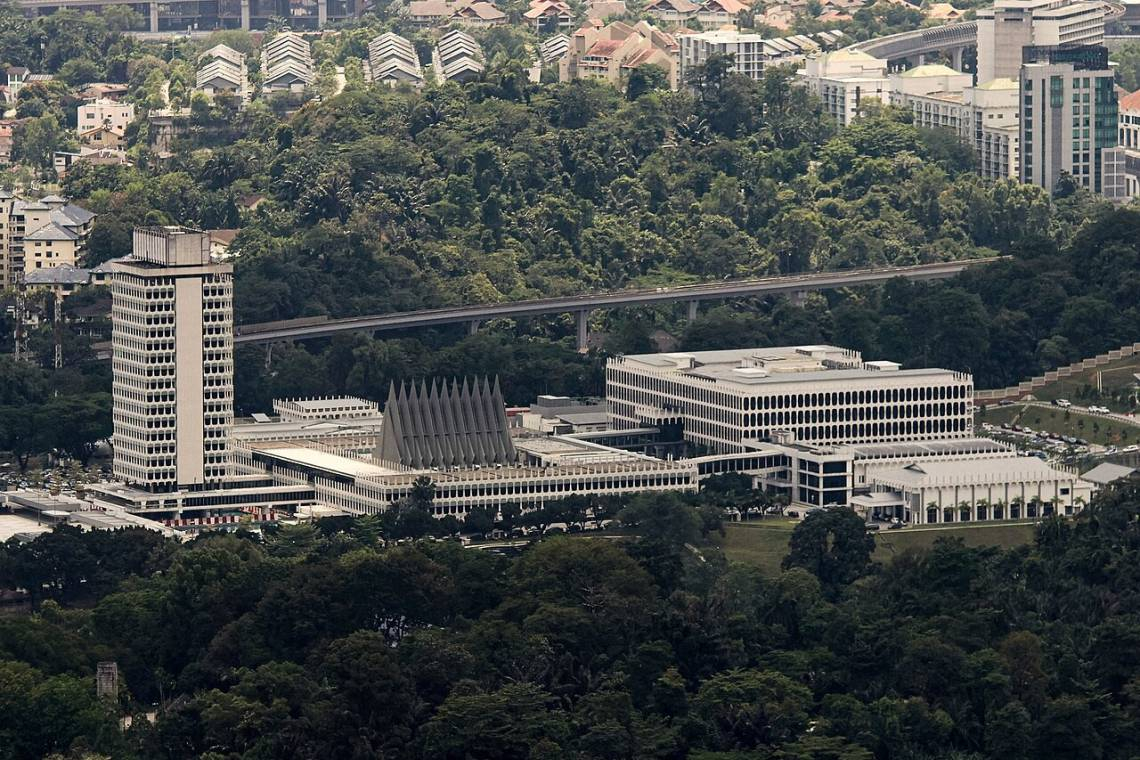
The Malaysian Parliament passed the Arbitration (Amendment) Act 2024 in July of that year, coming into force on January 1st 2026. It raises the level of required transparency of TPLF in Malaysia to standards not yet mandated in Europe. Image Source: Pangalau, Wikipedia
The Arbitration (Amendment) Act 2024, which came into force on 1 January 2026, introduces a formal framework aimed at enforcing transparency, accountability, and ethical conduct by funders. It joins jurisdictions like Singapore in providing a higher level of regulation and control over third-party litigation funding.
The prolonged and highly disruptive Sulu arbitration, which ran from 2019 until late 2025, has loomed large over discussions about the risks of unregulated funding. The involvement of the litigation funder Therium Capital Management in supporting the case has been widely cited as part of the broader context that led lawmakers to act, highlighting how third-party funding can magnify disputes far beyond their original scope when left unchecked.
Central to Malaysia’s new law is a Code of Practice that places responsibility squarely on funders. They are accountable not only for their own behavior but also for that of subsidiaries, related entities, and advisers. Funders must be transparent about their identity and ownership, and they are required to present their services honestly. Funded parties must be informed in writing of their right to seek independent legal advice, and every funding agreement must include core terms such as the amount of funding, the funder’s return, and a neutral mechanism for resolving disputes between funder and client.
“Funders are accountable not only for their own behavior but also for that of subsidiaries, related entities, and advisers.”
Updated headlines for free, straight to your inbox—no noise, just facts.
We collect your email only to send you updates. No third-party access. Ever. Your privacy matters. Read our Privacy Policy for full details.
The rules go further. Funders are subject to annual audits and must maintain systems to identify and manage conflicts of interest, protect confidential information, and ensure compliance with professional standards. Crucially, they are expressly prohibited from controlling the conduct of an arbitration or dictating settlement decisions, and they must not interfere with lawyers’ professional duties.
“Crucially, TPLF are expressly prohibited from controlling the conduct of an arbitration or dictating settlement decisions, and they must not interfere with lawyers’ professional duties.”
These safeguards map closely onto concerns raised by past funding practices during the Sulu arbitration and in other recent cases. Therium, for example, has been reported to have reserved rights to influence settlements in an earlier international litigation, Gbarabe v. Chevron. Other funders have also pressured clients to pursue claims against their own interests. In the UK, a high-profile consumer case involving Mastercard in 2025 drew attention to tensions between funders and legal advisers when the former attempted to block a settlement. Meanwhile, in the United States, a Chicago restaurant entrepreneur has brought claims last year alleging that his lawyers steered him toward costly litigation funding to facilitate the raising of their own legal fees while dragging on the case. Such disputes have fueled wider unease about who ultimately controls and benefits from funded litigation.
Questions of control and transparency have also surrounded the Sulu arbitration itself. Observers have long asked whether the driving force behind the case lay with the eight Filipino claimants, their legal teams, or the funders supporting them. The financial arrangements underpinning the proceedings have been opaque, prompting scrutiny over how funds were deployed, including reports of private intelligence and information campaign strategists being engaged and funded during the dispute.
“The financial arrangements of Therium have been opaque, prompting scrutiny over how funds were deployed, including reports of private intelligence and information campaign strategists being engaged and funded during the Sulu arbitration.”
Under Malaysia’s new framework, such opacity would no longer be acceptable. The law requires clarity on who is funding a case, which entities are associated with it, and forbids funders from usurping the decision-making authority of the funded party. The intent is not to eliminate TPLF, but to ensure it operates within clear ethical boundaries.
Indeed, some critics might argue the reforms could go further. Malaysia has chosen a middle path despite the significant turmoil caused by TPLF: preserving the potential of third-party funding to widen access to justice while imposing practical safeguards to prevent commercial exploitation of the legal system. It is a contrast to the United Kingdom, where TPLF has historically relied on self-regulation. Recent efforts to overturn the Supreme Court’s PACCAR ruling—which treated many funding arrangements as damages-based agreements and destabilized the market—continue to expose the fragility and pushback of a legal environment accustomed to a largely voluntary system.
Jurisdictional gaps thus remain a challenge. Even within nations, different approaches can still be exploited. The Sulu claimants, their funder, and legal advisers are now facing allegations of unlawful means conspiracy in Jersey, a jurisdiction with looser oversight than London and one that is believed to have served as a financial hub for the Sulu dispute’s activities in Spain and further afield.
“The Sulu claimants, their funder, and legal advisers are now facing allegations of unlawful means conspiracy in Jersey.”
Malaysia’s reforms suggest a growing recognition that clearer rules are needed. As cross-border litigation funding expands, the question may no longer be whether TPLF should be regulated, but whether other jurisdictions are prepared to follow suit.
REFERENCES
BHEUU. (2026, January 1). Arbitration Act 2005 Code of Practice for Third Party Funding 2026. https://strapi.bheuu.gov.my
Ismail, F. (2025, January 8). Arbitration (Amendment) Act 2024: Code of Practice for Third-Party Funding 2026. Richard Wee Chambers. https://www.richardweechambers.com/
KnowSulu. (2025, November 18). When funders fight justice: Innsworth to pay costs of obstructing £200 million settlement. https://knowsulu.ph/
KnowSulu. (2025, December 16). Chicago lawsuit highlights dangers of lawyer-funder relationships. https://knowsulu.ph/

KnowSulu is your trusted source for verified facts, news, and legal insights about the Sulu region. Committed to integrity, our mission is to empower the people of Sulu by providing accurate, transparent, and reliable information that matters.