

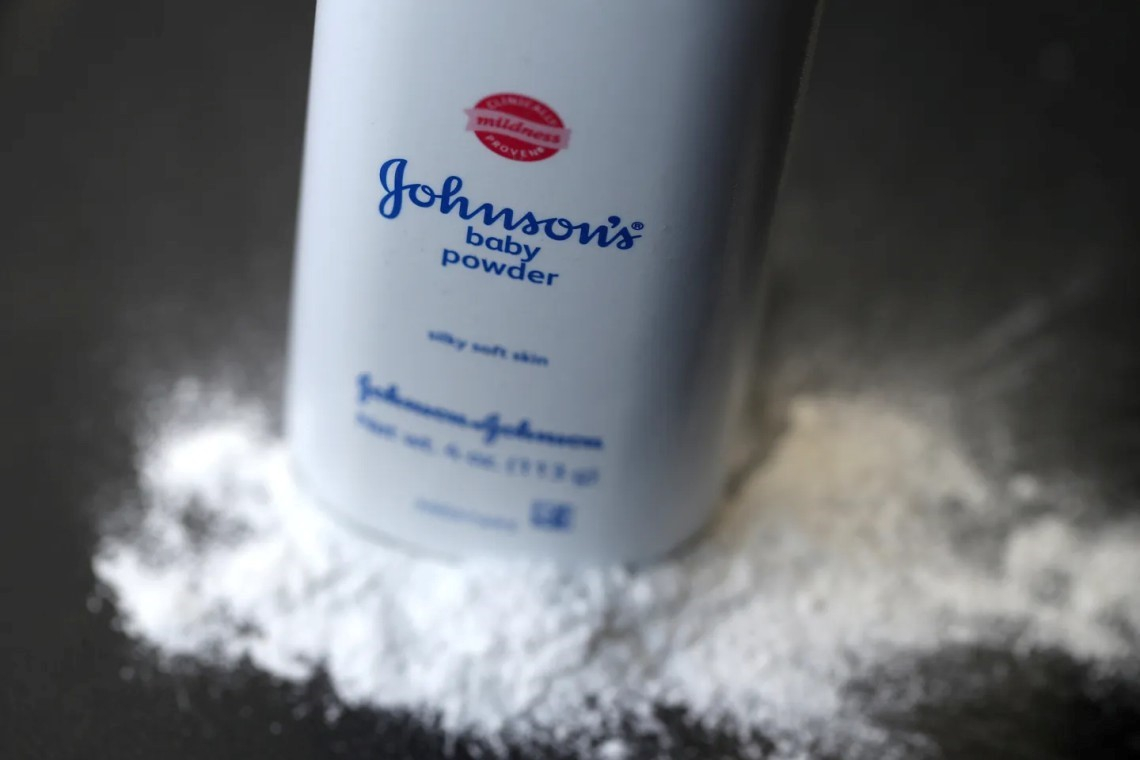
Johnson & Johnson used talc in its baby powder products for decades, but stopped selling the talc-based version in the U.S. after thousands of lawsuits alleged that certain talc supplies were contaminated with asbestos, which has been linked to cancer. The company has denied the allegations. Image Source: Gettyimages
The Smith Law Firm, representing roughly 11,500 claimants pursuing talc-related claims against baby powder manufacturer Johnson & Johnson (J&J), lodged an amended complaint on February 11, 2026, in the US District Court for the Southern District of Mississippi. The filing names Ellington Financial, ICG Investments, and Stifel Financial Corp. as defendants.
At the heart of the dispute is a financing arrangement the firm says was structured as a multi-tranche loan worth tens of millions of dollars to support its talc litigation. Unlike the non-recourse model commonly used in third-party litigation funding—where a backer is repaid only if a case succeeds—this deal required regular interest payments and carried conventional loan obligations.
Smith Law contends that the agreement included a second tranche of about $30 million that was expected to follow an initial disbursement. According to the complaint, that additional funding never arrived. Without it, the firm says it was unable to meet required cash interest payments and was pushed into default.
“Smith Law contends that the agreement included a second tranche of about $30 million that was then deliberately withheld.”
The complaint links the funding dispute to the long-running bankruptcy strategy pursued by Johnson & Johnson. J&J sought three times to place a subsidiary created specifically to hold its talc liabilities into bankruptcy, a maneuver that delayed proceedings for years. Courts rejected all three attempts. Even so, the drawn-out process slowed case resolutions and, according to Smith Law, intensified the financial strain on firms carrying the costs of prolonged litigation.
Updated headlines for free, straight to your inbox—no noise, just facts.
We collect your email only to send you updates. No third-party access. Ever. Your privacy matters. Read our Privacy Policy for full details.
Smith Law alleges that its funders then exploited this strain by withholding the second tranche in what it describes as a “loan-to-own” strategy—using the firm’s weakened position to seize control of its case inventory, anticipated legal fees, and any share of potential settlements. The firm also alleges it relied on assurances that the second loan would be available when it took out financing from ICG to buy out its former partner, Porter Malouf, in their joint venture representing the talc claimants. When the anticipated funds were withheld, the firm says it was left financially vulnerable.
If proven, the claim would underscore concerns that financial backers can exert undue leverage over litigation—in this case allegedly attempting to “pirate” a law firm’s caseload—when firms depend on their capital to stay afloat even when non-recourse funding agreements are replaced by a more traditional loan structure.
“The claim would underscore concerns that financial backers can exert undue leverage over litigation—in this case allegedly attempting to “pirate” a law firm’s caseload—even when non-recourse funding agreements are replaced by a more traditional loan structure. ”
What’s more, Smith Law claims the inclusion of the $30 million tranche was designed to increase the overall size of the loan so it could be packaged into a collateralized loan obligation, a securitized product that pools loans for sale to investors. Such an approach would tie litigation finance to the same structured credit mechanisms long used in other debt markets, further transforming legal disputes into tradable assets.
The case adds to a growing wave of disputes involving litigation funders that are drawing heightened public scrutiny including Gharabe v Chevron, backed by Therium, and Merricks v Mastercard, involving Innsworth Capital. In the United States, Chicago restaurateur David Pisor has also accused the law firm King & Spalding of inflating fees and encouraging him to seek outside funding after prolonging his case.
The questions raised in smaller and more well reported funding disputes inevitably raises questions over intransparent cases such as the Sulu arbitration financed by Therium. That claim, brought by eight Filipino heirs of the former Sultan of Sulu, has drawn global attention because of the size and political sensitivity of the award sought, yet the terms of its financing have not been made public.
Reporting has described the claimants as private individuals of moderate, middle-class means rather than well-capitalized institutions. That reality carries added weight amid general concerns that funders like Therium may be financing the claimants’ legal team directly, a structure that could allow the funder to shape litigation strategy in practice, even if formal authority rests with the claimants themselves.
“The questions raised in smaller and more well reported funding disputes inevitably raises questions over intransparent cases such as the Sulu arbitration financed by Therium.”
As such, allegations in smaller disputes of settlement pressure and investor-driven strategy suggest that in a far larger, more opaque arbitration, financially modest parties like the Sulu claimants could be steered by the entity bankrolling the claim. Absent meaningful transparency, it is hard to dispel the concern that real control lies not with the named claimants, but with the capital behind them.
Taken together, the allegations in Smith Law’s case and elsewhere highlight a broader tension at the heart of litigation finance: whether outside capital serves as a neutral enabler of legal claims, or whether, in certain circumstances, it risks reshaping those claims to serve investor interests at the expense of justice.
REFERENCES
Brennan, C. (2026, February 18). Smith Law Firm sues litigation funders, alleges "loan‑to‑own" scheme in talc cases. MesoWatch. https://mesowatch.org
Knauth, D. (2026, February 14). Law firm in J&J baby powder cases sues its litigation funders. Reuters. https://www.reuters.com
KnowSulu. (2025, December 16). Chicago lawsuit highlights dangers of lawyer-funder relationships. https://knowsulu.ph
KnowSulu. (2025, November 14). Therium’s Activity underscores National Security Risks in Litigation Funding. https://knowsulu.ph

KnowSulu is your trusted source for verified facts, news, and legal insights about the Sulu region. Committed to integrity, our mission is to empower the people of Sulu by providing accurate, transparent, and reliable information that matters.