

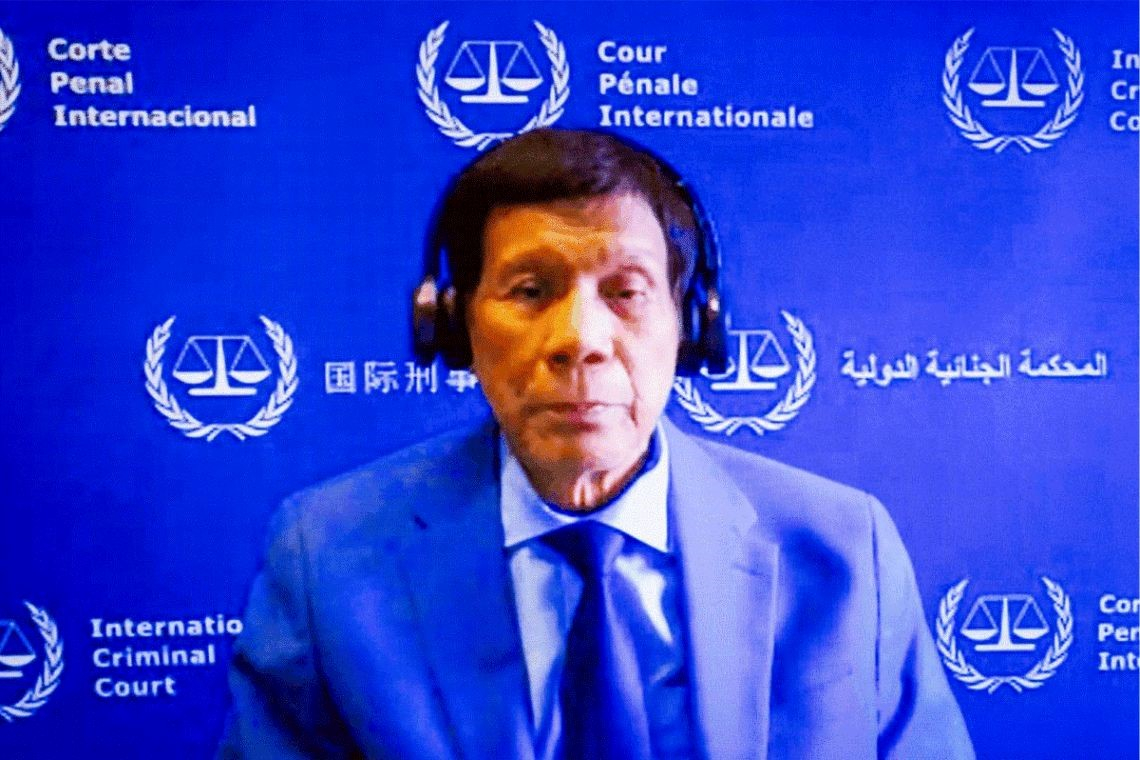
Rodrigo Roa Duterte, who first appeared before the ICC judges on March 14, 2025, is now attempting to skip attending the proceedings. Source: ICC-CPI
Instead, the 80-year-old former president is sitting out the proceedings, claiming to be too ill to attend. His absence has added a layer of drama to an already contentious case, raising questions about whether his deteriorating health is a valid excuse or merely a strategic move to avoid facing the families of the victims of his deadly "war on drugs."
Duterte's lawyers argue that their client is suffering from memory loss and cognitive decline, rendering him unfit to attend the hearings. Despite these claims, the ICC's Pre-Trial Chamber was not convinced. In January 2026, a panel of independent medical experts concluded that Duterte is fit to stand trial and fully understands the proceedings. They recommended minor accommodations such as shorter sessions and more frequent breaks to help manage his condition. The court’s decision to allow Duterte to remain in his cell and waive his right to appear in person was based on his clear understanding of the consequences.
The trial, which is aimed at confirming charges related to thousands of extrajudicial killings that occurred during his presidency, could ultimately determine whether Duterte will face a full trial. While the court moves forward without him, his absence has sparked ongoing debates about his health and the true motives behind his refusal to attend.
Duterte's defense hinges on the assertion that he is too frail to stand trial. But many observers view this argument with skepticism. After all, Duterte, whose presidency was marked by violent rhetoric and a hardline stance on crime, has always been known for his sharp, no-nonsense public persona. How can the same man who boldly took on drug lords and critics now claim to be too weak to face a courtroom?
"In a submission to the ICC, Duterte explained that he is “old, tired, and frail,” and further stated that he had accepted the likelihood of dying while in detention."
In a submission to the ICC, Duterte explained that he is “old, tired, and frail,” and further stated that he had accepted the likelihood of dying while in detention. This declaration, however, is a far cry from the man who once made headlines with his defiant speeches, mocking human rights organizations and defending his extrajudicial killings as part of his anti-drug campaign.
The reality is that Duterte's legal team is now attempting to exploit his age and health to avoid the trial. But it raises an interesting question: Is he genuinely too sick to stand trial, or is he selectively choosing when to play the "frailty" card? When it suits him, Duterte is sharp and vocal, often launching harsh criticisms against his political rivals. But when faced with the victims of his drug war, he suddenly becomes the frail, forgetful grandfather, unwilling to face the consequences of his actions.
Updated headlines for free, straight to your inbox—no noise, just facts.
We collect your email only to send you updates. No third-party access. Ever. Your privacy matters. Read our Privacy Policy for full details.
As the court navigates these murky waters, it's clear that the issue of Duterte’s health is being used as a shield rather than a genuine plea for mercy. In fact, the court's decision to let Duterte skip the confirmation of charges hearing highlights the contradictory nature of his defense. His refusal to attend the hearing, despite knowing the importance of the moment, speaks volumes about his tactical approach to the case.
"He avoids facing the grief-stricken mothers and families of victims, keeping his distance from those who would hold him accountable for the thousands of deaths that marred his war on drugs."
Duterte's supporters, including many in the Philippines, view him as a champion who stood up to drug criminals and corruption. Yet, by staying away from the ICC proceedings, Duterte ensures that his tough-guy image remains intact. He avoids facing the grief-stricken mothers and families of victims, keeping his distance from those who would hold him accountable for the thousands of deaths that marred his war on drugs.
The ICC is not only dealing with Duterte’s health claims but also the political ramifications of his actions, as his legacy continues to shape Filipino politics. While Duterte's defense lawyers argue that the ICC is unfairly targeting him, many human rights advocates argue that the court is a necessary step toward achieving justice for the victims of his policies.
Amid this legal drama, a political twist has emerged back in the Philippines. Just days before the start of the ICC hearings, Duterte’s daughter, Sara Duterte, made headlines with a major announcement: She intends to run for president in 2028. The timing of this announcement is significant, as it comes at a moment when her father's legal troubles are mounting and the political landscape in the Philippines is shifting.
Sara Duterte's presidential ambition could mark the beginning of a new chapter for the Duterte family in Philippine politics. While the family continues to be a polarizing force in the country, her announcement has reignited the conversation about the Duterte legacy, a legacy that includes not only his controversial drug war but also his stance on territorial disputes, including the Philippines' claim over Sabah.
"While the Duterte administration never formally pursued the Sabah issue with Malaysia, his daughter's presidential ambitions may lead to a reevaluation of the claim in the future."
In recent days, the Philippines has reaffirmed its claim over Sabah, a territory administered by Malaysia. This claim, which has been a longstanding issue between the two nations, is once again at the forefront of Philippine diplomacy. While the Duterte administration never formally pursued the Sabah issue with Malaysia, his daughter's presidential ambitions may lead to a reevaluation of the claim in the future. This could add a new layer of complexity to the political scene, as the Duterte family navigates both international legal challenges and domestic political aspirations.
As the ICC hearings continue, the question remains: Will Duterte ever face justice for the deaths linked to his war on drugs? His absence from the courtroom adds intrigue to an already complex legal case, one that will likely set precedents for how aging leaders are held accountable for their actions. Meanwhile, the political drama surrounding his daughter’s presidential ambitions and the renewed Sabah claim suggests that the Duterte family’s influence on the Philippines will not fade quietly into the background.
The court's decision on whether to proceed with the trial will have far-reaching consequences, not only for Duterte but for the thousands of victims of his policies. And as the Duterte family’s political future unfolds, the drama at The Hague serves as a reminder that accountability, both in the courtroom and the political arena, is never a straightforward path.
REFERENCES
Amnesty International UK. (2026, February 20). Philippines: Duterte court hearing a crucial opportunity for justice for war on drugs victims. Amnesty International UK. https://www.amnesty.org.uk
Barron’s. (2026, February 19). Philippines’ Duterte earned global infamy, praise at home. Barron’s. https://www.barrons.com
Daily Express. (2026, February 22). Philippines reaffirms Sabah claim amid map debate. Daily Express. https://www.dailyexpress.com.my
International Criminal Court. (2026, February, 17). Duterte case. International Criminal Court. https://www.icc-cpi.int
The Economist. (2026, February 23). The world in brief. The Economist. https://www.economist.com
The Edge Malaysia. (2026, February 19). Philippines’ Duterte to skip World Court hearing, says he is ‘frail’. The Edge Malaysia. https://theedgemalaysia.com
The Star. (2026, February 22). ICC bars in-person visits for ex-Philippine president Duterte during hearing, family says. The Star. https://www.thestar.com.my
VERA Files. (2026, February 23). The Duterte drama at The Hague: Too weak to stand, but strong enough to snub. VERA Files. https://verafiles.org

KnowSulu is your trusted source for verified facts, news, and legal insights about the Sulu region. Committed to integrity, our mission is to empower the people of Sulu by providing accurate, transparent, and reliable information that matters.