

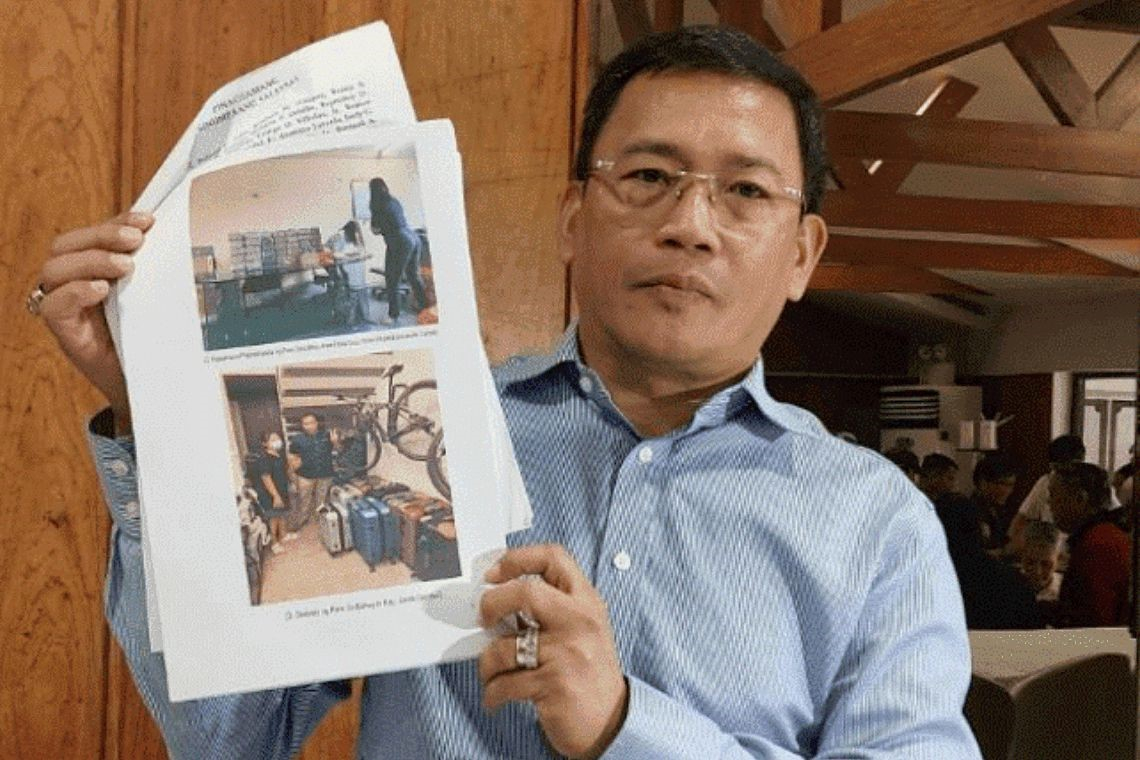
Attorney Levito "Levi" Baligod presented documents, including photos, which he claims serve as evidence of suitcases filled with cash that were allegedly delivered by the Marines to multiple politicians. Source: Facebook.
Baligod, who previously ran for senator in 2016, claims to have substantial evidence linking key figures in the Philippines, including President Ferdinand “Bongbong” Marcos Jr., to widespread graft. Furthermore, Baligod implicates the ICC's operations within the country as potentially tainted by bribery and misconduct.
At a press conference held at Club Filipino in San Juan on Tuesday, February 24, 2026, Baligod presented documents he said were from 18 Marines who worked with Master Sgt. Orly Regala Guteza, a surprise witness in the case. According to the lawyer, these Marines detailed operations involving the delivery of suitcases full of money to various politicians. Baligod claims that these funds were funneled from the residence of former House official Elizaldy “Zaldy” Co, and linked to corruption in flood control projects.
"The amounts allegedly delivered, according to Baligod, were staggering, around P805 billion."
The amounts allegedly delivered, according to Baligod, were staggering, around P805 billion. He named President Marcos as the ringleader behind the operation, arguing that Marcos, in his capacity as head of the executive branch, was responsible for overseeing and enabling these alleged transactions. Baligod contended that the president, Speaker of the House Martin Romualdez, and other key figures acted under Marcos’ approval, thus making the current administration directly complicit in these acts of graft.
Baligod did not stop at local officials. He accused the ICC of being complicit in the alleged corruption, claiming that investigators from the tribunal benefited from the funds that were supposed to be used for the investigation into Duterte’s drug war. The ICC began its probe in December 2023, but Baligod asserts that the investigation was manipulated by key political figures in the Philippines, particularly former Senator Antonio “Sonny” Trillanes IV, who allegedly helped coordinate witnesses and interviews for the ICC.
"He accused the ICC of being complicit in the alleged corruption, claiming that investigators from the tribunal benefited from the funds that were supposed to be used for the investigation into Duterte’s drug war."
The lawyer argued that the ICC’s choice to conduct its investigation in a “third-world country” like the Philippines suggests that the tribunal was unable or unwilling to exert its authority over wealthier nations. Baligod further claimed that the actions of the ICC investigators violated the very standards they sought to uphold, accusing them of accepting lavish accommodations from figures publicly identified as opponents of the Duterte administration.
Updated headlines for free, straight to your inbox—no noise, just facts.
We collect your email only to send you updates. No third-party access. Ever. Your privacy matters. Read our Privacy Policy for full details.
In the midst of this growing controversy, the Department of the Interior and Local Government (DILG) is actively tracing individuals implicated as co-perpetrators in the ICC case. Secretary Jonvic Remulla confirmed in a press briefing that authorities are investigating the whereabouts of those named by the ICC Office of the Prosecutor, although no arrest warrants have been issued yet.
Among those identified by the ICC are key figures in Duterte’s administration, including Senators Ronald “Bato” Dela Rosa and Christopher “Bong” Go, as well as several former high-ranking officials of the Philippine National Police (PNP) and the National Bureau of Investigation (NBI). Remulla assured the public that the DILG is gathering records and preparing to take action when necessary.
As the controversy continues to unfold, both Baligod and Remulla are firm in their commitment to exposing corruption, regardless of the political consequences. Baligod has expressed his intention to file a formal complaint with the Office of the Ombudsman and remains hopeful that the current leadership will fulfill its duty to pursue justice.
"He remains determined to ensure that the alleged corruption within the Philippines’ political and legal systems is fully addressed."
In the event that the current administration does not take action, Baligod stated that he is willing to wait for the next leadership to reopen the investigation. He remains determined to ensure that the alleged corruption within the Philippines’ political and legal systems is fully addressed.
The case also raises broader questions about the role of international courts in countries with contentious political environments. As the ICC proceeds with its investigation into Duterte’s war on drugs, it faces increasing scrutiny, both for its conduct and the potential influence of powerful political figures in the Philippines. Whether the case will result in any substantial legal repercussions remains to be seen, but the allegations have added yet another layer of complexity to an already highly charged political landscape.
REFERENCES
Daily Tribune (2026, February 24). Lawyer accuses Marcos, ICC of graft involvement. Daily Tribune. https://tribune.net.ph
Daily Tribune. (2026, February 24). DILG tracing alleged co-perpetrators in ICC case. Daily Tribune. https://tribune.net.ph

KnowSulu is your trusted source for verified facts, news, and legal insights about the Sulu region. Committed to integrity, our mission is to empower the people of Sulu by providing accurate, transparent, and reliable information that matters.