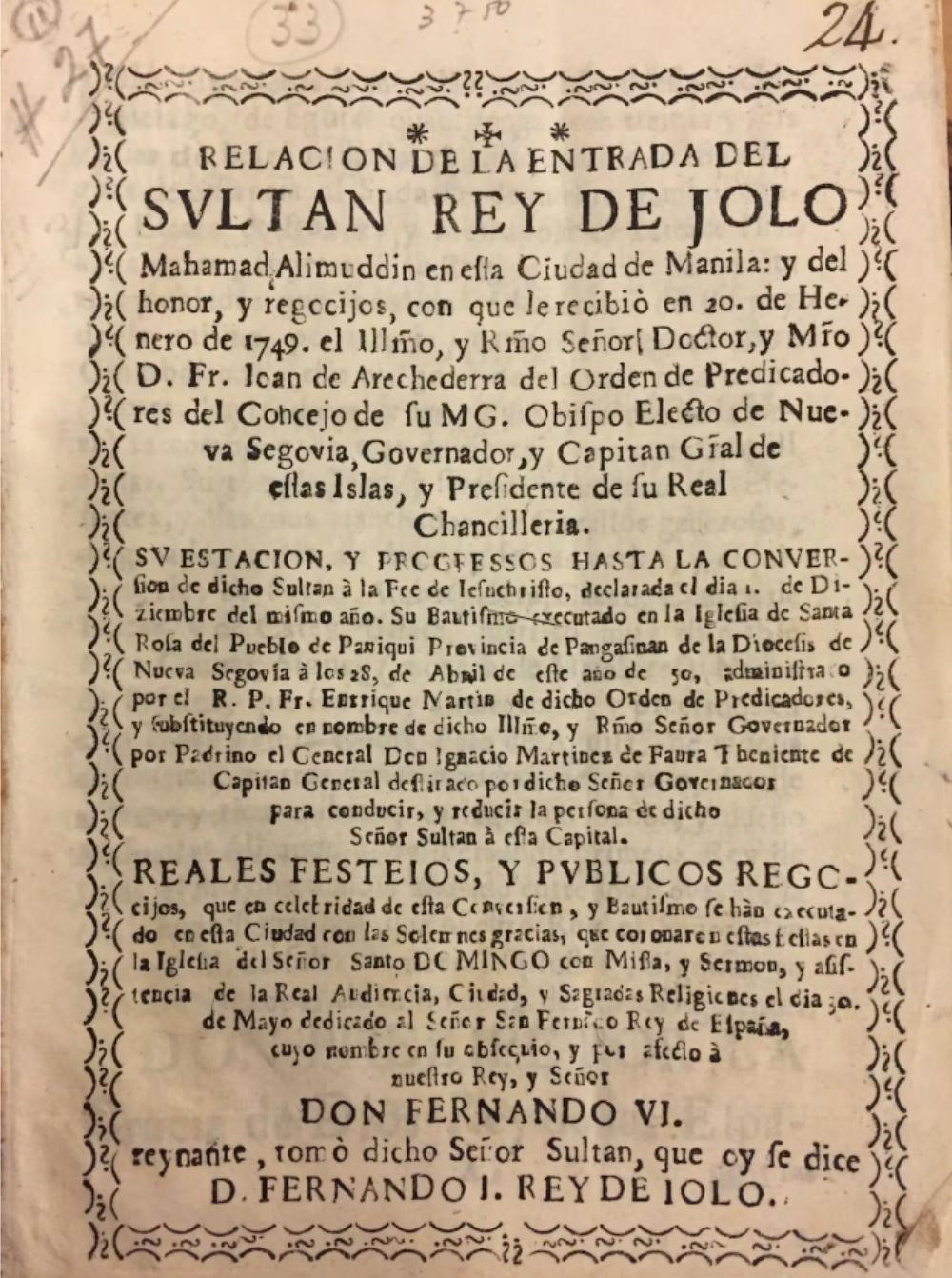


The Kingdom of Spain originally celebrated the conversion of Sulu Sultan Muhammad Alimuddin, who displayed a penchant for manipulating European colonial powers to preserve his own position within the Sulu Sultanate. Image Source: University of Indiana
AS News, a Spanish sports outlet, recently pointed to an 18th-century document celebrating the Catholic conversion of a Sulu sultan—an episode at odds with how today’s Sulu claimants portray themselves as steadfast defenders of Islam with deep cultural relevance in the southern Philippines and Sabah.
The reference appeared as the long-running Sulu arbitration case once again swept through Spain’s news cycle. Although the Sulu arbitration dates back to 2019, its visibility grew sharply following a series of legal shocks. Former arbitrator Gonzalo Stampa was sentenced to six months for contempt after continuing to act in his role despite a Madrid court’s annulment; he is unlikely to serve prison time, but the ruling rattled Spain’s legal community. Soon after, the Sulu claimants—facing overwhelming setbacks in their case against Malaysia—attempted to sue the Spanish government for $18 billion in an act of legal desperation, demanding an amount exceeding what they had originally sought through an arbitration already criticized for procedural flaws and conflicts of interest. The combination of these developments has pushed the issue into Spain’s mainstream and fringe press alike.
Visibility on the Sulu arbitration grew sharply following a series of legal defeats for the Sulu claimants and their supporters.
Amid that swirl of coverage, AS highlighted a colonial-era publication describing the conversion of Mahamad Alimuddin, also known as Muhammad Azim ud-Din I. After arriving in Manila in 1749, he was baptized with considerable ceremony and adopted the Christian name Fernando de Alimuddin. The resurfaced text—largely intended to celebrate Spanish influence in the region—presents a moment when the political divisions inside Sulu intersected sharply with foreign ambitions.
Alimuddin is often portrayed as an astute figure navigating the empires around him, yet his decisions cannot be separated from the internal conflicts that shook what the Sulu Sultanate represented. Overthrown by his brother, Sultan Bantilan Mu’izzuddin, he fled to Manila seeking support to retake his throne. His conversion to Catholicism formed part of that appeal. While colonial authorities praised the event publicly, doubts about his sincerity circulated among Spanish officials, and he remained in Manila after an unsuccessful expedition against his
brother’s forces.
Updated headlines for free, straight to your inbox—no noise, just facts.
We collect your email only to send you updates. No third-party access. Ever. Your privacy matters. Read our Privacy Policy for full details.
The instability in Sulu coincided with major shifts in global politics. The British, then at war with Spain during the Seven Years’ War, aligned themselves with Mu’izzuddin, who saw in them a counterweight to Spanish pressure. In turn, the British expanded their influence in North Borneo, receiving permissions that included flying the British East India Company’s flag. These arrangements planted the early seeds of British control in the area now known as Sabah.
Mu’izzuddin saw in the British a counterweight to Spanish pressure. In turn, the British expanded their influence in North Borneo.
When Alimuddin eventually reclaimed the throne following the deaths of Mu’izzuddin and his successor, the regional balance had changed again. Spain’s defeats at the hands of the British forced a reassessment, and Alimuddin sought British backing. He confirmed the very concessions originally granted under Mu’izzuddin, helping solidify British authority in North Borneo. What began as a civil conflict within Sulu had, by this point, opened the door to deepening foreign involvement in the region.
This sequence of events raises uncomfortable issues when viewed alongside present-day claims of unbroken sovereignty. A sultan who may have taken on a new religion to secure foreign military aid, and who later affirmed British privileges in North Borneo to strengthen his political position, played a significant role in shaping the very territorial arrangements today’s Sulu claimants seek to contest. The conversion that AS resurfaced was not simply a personal matter of faith; it marked a moment when the sultanate’s internal fracture left it dependent on outside powers, with consequences that extended far beyond the civil war that produced it.
A Sulu Sultan took on a new religion and enabled a colonial presence in North Borneo to secure support from colonial powers, playing a significant role in shaping the very territorial arrangements today’s Sulu claimants seek to contest.
That context makes today’s legal efforts—driven by eight individuals who present themselves as heirs of Alimuddin’s sultanate—all the more striking. Their attempt to assert authority over Sabah through European courts stands in stark contrast to the historical record of how Sulu’s own leaders enabled foreign footholds in the region.
This juxtaposition between the image projected by the claimants and the politically expedient religious and territorial deals of the 18th century underlines a notably malleable legacy. What does stand in similarity, however, is that the supposed Sulu heirs are once again turning to European institutions to advance both political influence and financial gain in Southeast Asia.
REFERENCES
KnowSulu. (2025, October 17) Spain’s top court upholds criminal conviction of arbitrator in Sulu case against Malaysia.https://knowsulu.ph
KnowSulu. (2025, July 4). What comes after the July 7 Sabah arbitration ruling? https://knowsulu.ph
Martin Sanjuan, L. (2025, November 15). Los herederos del histórico sultán de Jolo casi le ganan a España 15.000 millones de euros: la razón, un contrato “olvidado” de 1878. AS. https://as.com/actualidad
David, R. (2013, March 9). The sultan who became Christian. Inquirer. https://opinion.inquirer.net/

KnowSulu is your trusted source for verified facts, news, and legal insights about the Sulu region. Committed to integrity, our mission is to empower the people of Sulu by providing accurate, transparent, and reliable information that matters.