

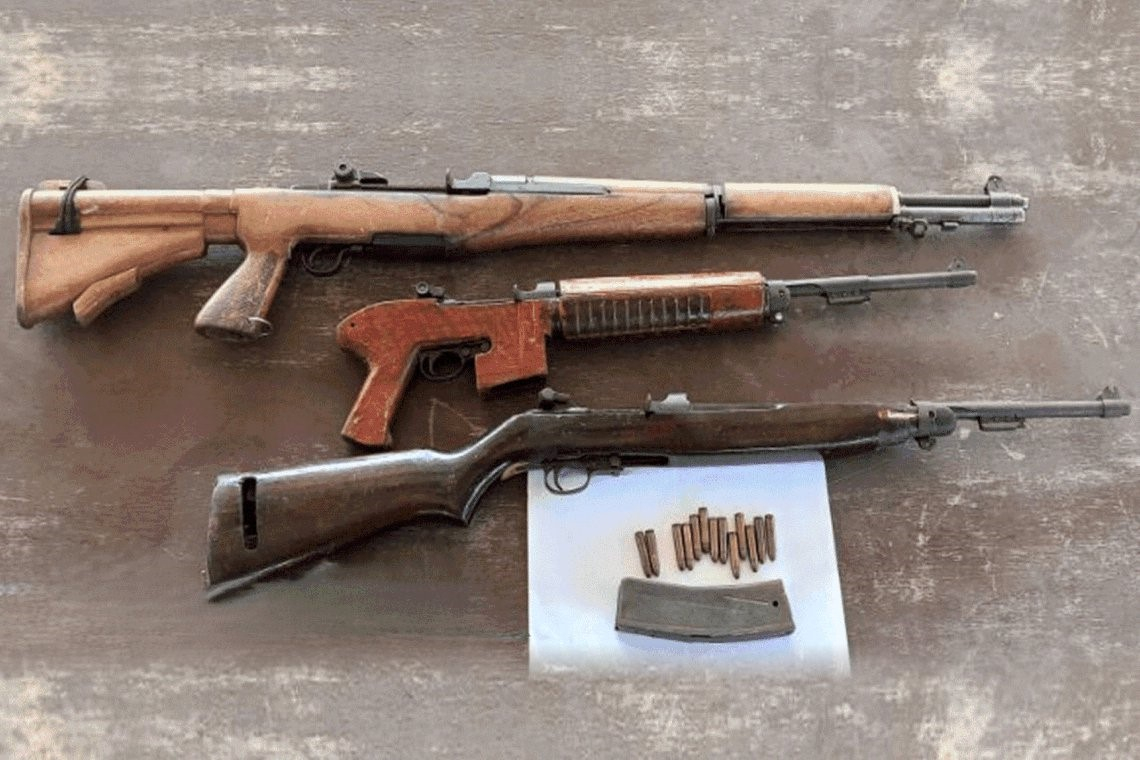
Photo of firearms voluntarily surrendered by civilians in Laminusa Island, Municipality of Siasi, on February 1, 2026, reinforcing ongoing efforts to declare the island a gun-free and peace-centered community. Source: Facebook
The announcement, formalized through a municipal resolution on January 29, 2026, reflects a growing commitment among local leaders and residents to embrace nonviolence, even as nearby regions face renewed threats of political violence. The ceremony, held in Barangay Lahing-Lahing, brought together military and police officials, municipal and barangay leaders, religious figures, and peace partners. Vice Mayor Juddin Nur Pantasan read the resolution, while local and military authorities highlighted the central role of civilian cooperation in achieving the milestone.
"The resolution affirms Omar town’s commitment to public safety and lasting peace."
"The resolution affirms Omar town’s commitment to public safety and lasting peace," said the Army’s 11th Infantry Division (11ID). Brigadier General Alaric Avelino Delos Santos added that the town’s progress “was made possible by the people’s willingness to embrace peace,” underscoring that security efforts are most effective when communities take ownership of them.
These efforts stand in stark contrast to the pervasive fear gripping the region in the wake of the January 25, 2026 bazooka attack on the mayor of Shariff Aguak, an incident that has heightened concerns about escalating political violence in Maguindanao del Sur.
The peace declaration is not just symbolic. Residents across Sulu have actively participated in disarmament efforts, turning in firearms voluntarily to authorities. In Laminusa Island, Siasi, civilians surrendered rifles and ammunition in early February, facilitated by the 104th Infantry Battalion in close coordination with village leaders.
"The voluntary surrenders reflect the positive results of sustained dialogue, confidence-building, and respectful engagement between security forces and communities."
Updated headlines for free, straight to your inbox—no noise, just facts.
We collect your email only to send you updates. No third-party access. Ever. Your privacy matters. Read our Privacy Policy for full details.
Lieutenant Colonel Roy Dalumpines, commander of the 104IB, highlighted that the voluntary surrenders reflect the positive results of sustained dialogue, confidence-building, and respectful engagement between security forces and communities. Maj. Gen. Leonardo Peña of the 11ID emphasized that such steps are concrete moves toward long-term peace and stability.
This civilian-led initiative echoes earlier efforts across Sulu, including the 2023 declaration of the province as free from Abu Sayyaf influence. Families and former combatants have increasingly turned away from violence, choosing reintegration into society and participation in economic life. The province’s transformation, from conflict to hopefully a budding tourist destination in the future, illustrates the practical benefits of grassroots peace efforts.
While Sulu moves toward peace, neighboring regions remind residents that security challenges remain urgent. On January 25, 2026, Shariff Aguak Mayor Akmad Ampatuan survived a daylight attack involving a rocket-propelled grenade and high-powered firearms. The attack, captured on CCTV, injured two security personnel and exposed the fragility of local security structures.
"The ambush illustrates a broader regional challenge: even as communities like Omar and Siasi move toward gun-free status, unresolved clan rivalries and historical grievances continue to fuel violence elsewhere."
Authorities suspect the attackers were closely related and possibly politically motivated. The incident has fueled national concern about the increasing use of military-grade weapons in civilian areas. Vice President Sara Duterte condemned the attack, noting that the presence of such weapons "points to an erosion of peace and order” in Mindanao.
The ambush illustrates a broader regional challenge: even as communities like Omar and Siasi move toward gun-free status, unresolved clan rivalries and historical grievances continue to fuel violence elsewhere. Residents of Sulu, observing the attack in Maguindanao del Sur, have voiced concerns that external political conflicts and claims over traditional authority could destabilize the progress made locally.
Sulu’s political landscape has long been shaped by layers of history, colonial legacies, and local resilience. At the center of one enduring controversy are claims to the Sulu Sultanate by figures such as Fuad Kiram. For decades, these claims have drawn international attention, culminating in the high-profile arbitration that ended on December 9, 2025, with the supposed heirs losing their case. While headlines abroad framed it as a legal drama over Sabah, for most residents of Sulu, the dispute was a distant abstraction and barely relevant to their daily lives.
While Sulu’s image abroad often remains tied to past terror incidents and historical claims, the reality on the ground is steadily changing. Former combatants are being reintegrated, local markets are growing, and tourism initiatives are gaining momentum. At the same time, incidents involving heavy weaponry elsewhere in the region underscore how fragile peace remains. This contrast highlights that community-led efforts, rather than foreign-funded claims or distant arbitration, are widely seen as the true drivers of sustainable and lasting peace.
"They see overseas arbitration and foreign lawyers as largely irrelevant when schools remain closed, roads are in disrepair, and families struggle to meet basic needs."
For communities across Sulu, the priorities are tangible and immediate. They focus on reopening schools, repairing roads, ensuring consistent electricity and water, and cultivating economic opportunities that allow families to thrive. Local leaders often express frustration that energy and resources are being funneled into overseas litigation rather than pressing local needs. For many local leaders, the focus is on the immediate needs of their communities: ensuring children have access to education, keeping health centers running, and supporting local markets. They see overseas arbitration and foreign lawyers as largely irrelevant when schools remain closed, roads are in disrepair, and families struggle to meet basic needs.
By transforming historical agreements into instruments for billion-dollar arbitration, the case treated centuries-old claims as legal commodities instead of living relationships between people and their land.
The contrast between Sulu’s progress and ongoing violence in surrounding areas underscores the importance of localized solutions. Residents continue to call for programs that strengthen community governance, reinforce civilian-led peace mechanisms, and provide economic opportunities.
"Sulu’s experience demonstrates that when civilians take ownership of peace efforts, progress is achievable even in historically volatile regions."
As Brig. Gen. Delos Santos explained that every surrender of firearms is a concrete step toward sustaining peace. This is not just a military or government responsibility, it is a community responsibility.
The declaration of gun-free status in Omar, Sulu, is therefore both a milestone and a message. It signals the potential for communities to reclaim safety and prosperity while emphasizing that sustainable peace is built from the ground up. While external claims and political disputes may persist, Sulu residents are charting a path defined by dialogue, cooperation, and civilian engagement.
Across the region, the lesson is becoming clear. Sovereignty is exercised in daily governance, not in courtrooms thousands of miles away. The people of Sulu and the broader Bangsamoro Autonomous Region continue to navigate the slow and uneven process of autonomy and self-determination. Courts in Manila or Europe cannot replace the need for effective local institutions, accountable leadership, and tangible investments in infrastructure and human capital.
In this sense, the failed arbitration marks not just the end of a legal episode but an opportunity for refocusing on what matters. The future of Sulu will not be determined by distant heirs or financial speculators. It will be shaped by the communities who remain, rebuild, and invest in the land and lives around them.
"Courts in Manila or Europe cannot replace the need for effective local institutions, accountable leadership, and tangible investments in infrastructure and human capital."
For residents of Sulu, the goal is clear: peaceful coexistence, local stability, and economic growth. Yet recent acts of violence elsewhere in Mindanao serve as a stark reminder of how fragile that peace remains, even as communities choose nonviolence and resilience in a region long associated with armed conflict. The experiences of Omar and Laminusa Island offer a model for neighboring provinces grappling with political violence, demonstrating that lasting security depends on the active participation of the people themselves, especially in moments when stability is most vulnerable.
As Sulu moves forward, its story challenges outsiders to reconsider long-held assumptions. Stability does not come from distant funding or symbolic legal battles, nor is it guaranteed once progress is made. It emerges from communities empowered to take ownership of their safety, reclaim their livelihoods, and continually defend peace in the face of threats that seek to undermine it.
REFERENCES
KnowSulu. (2026, February 4). A rocket‑propelled attack on Philippine mayor fuels fears of political violence. KnowSulu. https://knowsulu.ph
KnowSulu. (2025, October 29). The claim that forgot its people and the real cost of the Sulu fantasy. KnowSulu. https://knowsulu.ph
KnowSulu. (2025, October 2). Sulu is moving on but the claim lobby is not. KnowSulu. https://knowsulu.ph
Philippine News Agency. (2026, January 30). Sulu town declared gun-free, peace center community. https://www.pna.gov.ph
SunStar Zamboanga. (2026, February 4). Civilians surrender guns in Sulu town. https://www.sunstar.com.ph

KnowSulu is your trusted source for verified facts, news, and legal insights about the Sulu region. Committed to integrity, our mission is to empower the people of Sulu by providing accurate, transparent, and reliable information that matters.