

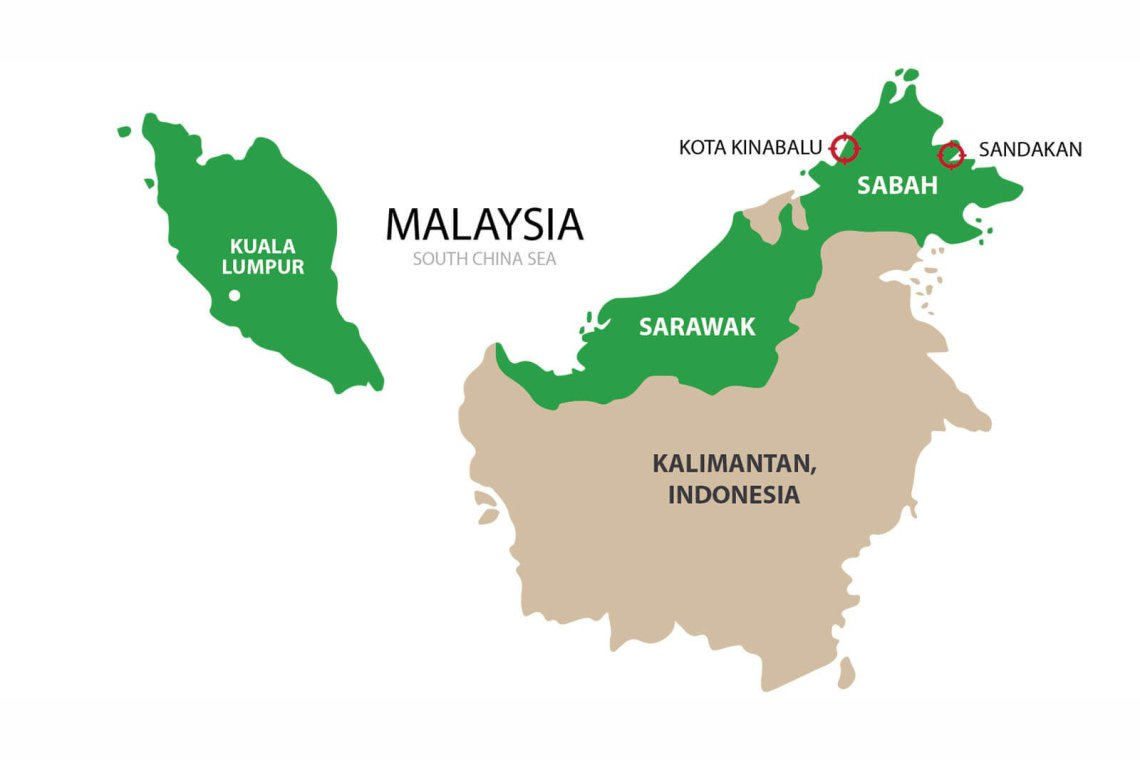
Sabah joined the Malaysian Federation in 1963 after the UN-backed Cobbold Commission found a majority of the population supported the union. Differences with Indonesia and the Philippines were resolved within a decade, a peace that was jeopardized by a militant invasion aligned with the purported Sulu heirs during the 2013 Lahad Datu Incident. Image Source: BorneoEcoTours
Reporting by Bernama highlighted remarks from Mohd Zarul Midi, a MADANI community leader in Kampung Gum-Gum, who said recent court developments reinforced Sabah’s sovereignty and its place within the Malaysian federation. Similarly, Sabah Chief Minister Hajiji Noor has also underlined this point in December 2025, saying that the ruling by the Paris Court of Appeal once again confirmed the position Sabah has consistently maintained.
International coverage has largely framed the dispute as a confrontation between Malaysia and the Sulu claimants. While that framing is accurate, another central reality must also be acknowledged: ordinary Sabahans are among those most directly targeted by the Sulu claimants. The Sulu claimants’ $15bn arbitral demand is based on the economic value of Sabah’s land and resources, not on sovereignty in the abstract. That makes Sabahans more than spectators with their rights and livelihoods leveraged by foreign Sulu claimants.
“Ordinary Sabahans are among those most directly targeted by the Sulu claimants.”
This context matters because the modern international system is built around the idea of self-determination. The United Nations Charter places this principle at its core, stating that harmony between nations must be “based on respect for the principle of equal rights and self-determination of peoples.” Put simply, decisions about Sabah’s future should be guided above all by the wishes of Sabahans themselves rather than by external actors invoking long-disputed historical claims.
“UN principles suggest decisions about Sabah’s future should be guided above all by the wishes of Sabahans themselves rather than by external actors invoking long-disputed historical claims.”
Following the Paris Court of Appeal’s final dismissal of the Sulu arbitration in December 2025, the claimants’ legal team has indicated it may seek to pursue the dispute beyond national courts and into the UN system. There are reports an International Court of Justice official said in 2004 a petition linked to the Sabah dispute could be referred to the UN General Assembly if endorsed by a major state such as the United States, China, or the Philippines.
The claimants’ renewed interest in this route echoes remarks made in a November 2024 interview, in which their lawyers suggested involving countries like China as a possible pathway to the UN. Yet this strategy appears to run against the very principles the UN is built to uphold, as the clearly expressed will of Sabah’s population—central to the UN’s doctrine of self-determination—has little place in the claimants’ case, calling into question what meaningful outcome such an appeal could realistically achieve.
“It’s questionable what an appeal to the UN against the self-determination of Sabahans can achieve.”
Updated headlines for free, straight to your inbox—no noise, just facts.
We collect your email only to send you updates. No third-party access. Ever. Your privacy matters. Read our Privacy Policy for full details.
The claimants have also struggled to present a coherent narrative about whom they represent. At various points, they have attempted to portray themselves as speaking for both modern inhabitants of Sulu in the Philippines and Sabah in Malaysia. Yet this claim has rarely been substantiated in practice. Assertions that compensation extracted from Malaysia would be reinvested for the benefit of both communities have remained vague or conceptually preposterous, with no detailed proposals or accountability mechanisms offered.
It is difficult to escape the impression that the case is ultimately about money rather than governance, representation, or welfare. Suggestions that the claimants seek control over Sabah strain credibility, not least because there is no indication they possess either the mandate or the capacity to govern the state. Instead, the pursuit of a multibillion-dollar payout appears to rely on leveraging distant and contested historical claims, rather than on the consent of any contemporary population.
“The Sulu claimants’ case is ultimately about money rather than governance, representation, or welfare.”
Such an approach sits uneasily with the internationally accepted principle of self-determination, particularly when arguments are litigated in European courts far removed from the people whose future is at stake. It also overlooks the interests of people in Sulu, in the southern Philippines, many of whom have shown little enthusiasm for a high-risk international legal campaign launched by a small group of individuals who do not legally represent them. As the dispute evolves, the central issue remains unchanged: the voices that matter most are those of the people who live in Sabah and whose political choices have long been made clear.
REFERENCES
Bernama. (2026, January 1). Legal triumphs prove Sulu heirs’ claims baseless, say Sabah East Coast residents. https://www.bernama.com/
Bernama. (2025, December 11). Hajiji: Paris court ruling a victory for Malaysia, affirms Sabah sovereignty. The Edge Malaysia. https://theedgemalaysia.com/
KnowSulu. (2025, October 16). Plotting a lease of Sabah: The Sulu heirs’ China gambit. https://knowsulu.ph/
United Nations. (n.d.). Chapter I: Purposes and principles. https://www.un.org/

KnowSulu is your trusted source for verified facts, news, and legal insights about the Sulu region. Committed to integrity, our mission is to empower the people of Sulu by providing accurate, transparent, and reliable information that matters.