

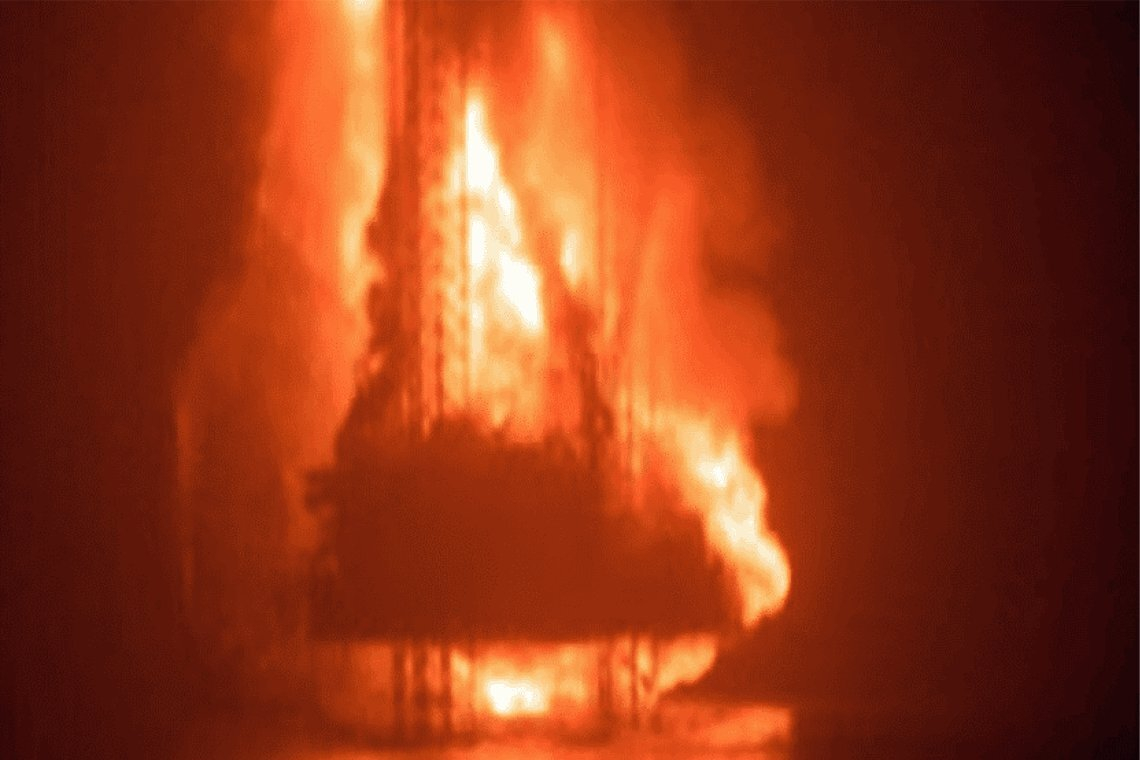
KS Endeavor Explosion Off Nigerian Coast. Source: Chevron
But in the case of Gbarabe v. Chevron, the company’s financial dealings were suddenly exposed to public scrutiny. And the results were far from flattering. The case offers a cautionary tale about the risks and pitfalls of litigation funding, and the role Therium played in it should raise red flags for anyone considering its involvement in future litigation.
Currently embroiled in another contentious case—the Sulu heir dispute—Therium is once again facing intense pressure to open its books. The issue at hand is not just its financial backing, but whether its opaque practices are playing a role in the manipulation of justice. As courts demand more transparency in litigation funding deals, Therium's reluctance to disclose the full extent of its funding arrangements may come back to haunt it.
"Therium's case history raises an important question: Is Therium terrified of reliving the embarrassment of its past mistakes?"
Therium's case history raises an important question: Is Therium terrified of reliving the embarrassment of its past mistakes? The Gbarabe case, which collapsed under its weight, unmasked the industry's dirty laundry and left Therium scrambling to defend its practices.
Updated headlines for free, straight to your inbox—no noise, just facts.
We collect your email only to send you updates. No third-party access. Ever. Your privacy matters. Read our Privacy Policy for full details.
The Gbarabe v. Chevron case, filed in 2014, involved a class action from Nigerians claiming damages from a gas rig explosion two years earlier. Lawyers Jacqueline Perry and Neil Fraser, with funding from Therium, represented the plaintiffs. However, during pretrial discovery, Chevron’s defense team, led by Jones Day law firm, uncovered that the case was heavily influenced by third-party funding from Therium—information the plaintiffs’ attorneys had initially concealed.
Jones Day deposed 36 class members in Nigeria, uncovering forged and inflated claims of injury and property damage. This evidence, exposed in Jones Day’s opposition to class certification, led the court to reject the plaintiffs' motion, citing unreliable evidence. Chevron questioned whether Perry and Fraser could adequately represent the class. They argued that the plaintiffs' attorneys were financially dependent on Therium, and that this created a conflict of interest.
"They argued that the plaintiffs' attorneys were financially dependent on Therium, and that this created a conflict of interest."
The real kicker came when the court demanded full disclosure of the funding agreement, which Therium had attempted to keep heavily redacted. The agreement revealed that Therium stood to receive up to six times its initial investment if the case succeeded, prompting concerns that Perry and Fraser’s financial dependence on Therium could compromise their ability to act in the plaintiffs' best interests.
The Gbarabe case was ultimately a failure. U.S. District Judge dismissed the class certification motion, criticizing Perry and Fraser’s handling of the case. The plaintiffs' attorneys had become entangled in the interests of a third-party funder whose primary concern was not the merits of the case but the return on its investment. It wasn’t just about winning, it was about securing the maximum return on investment, regardless of the justice owed to the plaintiffs.
"Therium's involvement in the case was not just a minor detail. It was a critical factor that contributed to the failure."
Therium's involvement in the case was not just a minor detail. It was a critical factor that contributed to the failure. When a litigation funder has the power to control a case’s direction, as Therium did, the interests of the plaintiffs often take a back seat. In the case of Gbarabe, the collapse of the litigation can partly be attributed to this misalignment of incentives. Perry and Fraser were pushing for a big win to satisfy Therium’s financial interests, not necessarily because they believed in the strength of their case.
The saga of Gbarabe v. Chevron was a wake-up call for the litigation finance industry, revealing how third-party funders like Therium can wield disproportionate influence over legal outcomes. With courts demanding more transparency in funding deals and the public increasingly aware of the ethical dilemmas posed by such arrangements, it is clear that litigation funding, as it stands, is far from a harmless tool for access to justice. Instead, it is a financial minefield that has the potential to distort the legal process and undermine the interests of plaintiffs.
For Therium, the question is no longer whether it will be held accountable, but how many more cases like Gbarabe will it need to lose before the system forces it to open its books? As the company faces scrutiny in the Sulu heir case, one thing is certain: its days of operating in the shadows may be numbered.
REFERENCES
DocumentCloud. (2016). Funding agreement. https://www.documentcloud.org
Forbes (2016, October 20). New to U.S., Funder Commits More Than $1.5M to Class Action Against Chevron. Forbes. https://www.forbes.com
Hancock, B. (2017, October 29). How Jones Day unmasked a litigation funding deal and won. The American Lawyer. https://www.law.com
Iovino, N. (2016, December 9). Chevron fights $1.5 billion claim over Nigerian gas rig blast. Courthouse News. https://www.courthousenews.com
Jones Day. (2017). Chevron defeats class action relating to offshore gas rig explosion in Nigeria. Jones Day. https://www.jonesday.com
KnowSulu. (2025, November 14). Therium's activity underscores national security risks in litigation funding. KnowSulu. https://knowsulu.ph
KnowSulu. (2025, November 10). Legal counteroffensive builds against Sulu claimants, lawyers, and funder. KnowSulu. https://knowsulu.ph
Skadden, Arps, Slate, Meagher & Flom LLP. (2017). Class Action Chronicle: Summer 2017 (Vol. 2, Issue 1). Retrieved from https://www.skadden.com

KnowSulu is your trusted source for verified facts, news, and legal insights about the Sulu region. Committed to integrity, our mission is to empower the people of Sulu by providing accurate, transparent, and reliable information that matters.